How Machine Learning Enterprise in Canada Is Reshaping Data Management in 2026 ?
5 July 2026
The global landscape of BI-powered data management has undergone a transition phase over the last few years. The increasing adoption of machine learning enterprise in Canada-based start-up has increased demand for an AI-integrated, scalable data platform to reduce the operational gaps between leadership goals and business reality.
However, in more than 57% of the cases, it has been seen that most of the Canadian startups have not fully adopted the use of Enterprise ML in their businesses until now.
Why Applied Enterprise Machine Learning in Canada Is a Priority for Boardroom Decision Makers?
The rise of applied machine learning has reshaped the entire AI-first, Gen AI-augmented ecosystem in various ways. Earlier, data-driven decision-making focused primarily on expanding business opportunities and Data Consulting Services For Business Growth.
But in 2026, the use of enterprise ML in business is all about leveraging predictive analytics solutions in every business. Most of the Canadian small businesses now explore better ways to execute data governance, implement business intelligence tools and other progressive machine learning models and LLMs (Large Language Models) to: –
- Automate metadata
- Establish AI dominance to turn unorganized corporate and business data into revenue-generating decisions
- Strengthen compliance with Canadian data privacy regulations, etc.
Moreover, ML program experts believe that modern tactics of applied machine learning in Canada are no longer restricted to dashboards and risk forecasting to improve the decision-making process. Rather, the leadership teams are shifting towards a machine learning enterprise in Canada to eliminate inconsistent data by reinforcing competitive decisions with Power BI-driven strategic solutions.
Industry analysts expect machine learning and automation capabilities to play a significantly larger role in enterprise data operations over the next few years. They claimed that:-
- Automation is expected to handle a growing share of repetitive operational tasks, while modern data platforms will continue using AI-powered analytics for CEO’s to take better business decisions.
- Automation will transform the mechanism of global data management
- 60% of the tasks will be automated, whereas 75% of new data flows help non-tech users to initiate data-driven decision making with enterprise AI adaptation in their business
- In the next few years, the leadership teams will expect data-driven decision-making answers from data teams solving their queries in terms of revenue improvement, cost reduction and risk mitigation.
That’s why modern Canadian businesses prefer to measure their business performance with ML business use cases to avoid bad decisions in advance.
4 Ways to Reshape Measurable Outcomes with ML Business Use Cases
- Optimizing Market ROI with Predictive Analytics
Using classification models to track Customer Churn Rate helps Canadian businesses to increase overall CLV (Customer Lifetime Value) in their business. Implementation of tools like AWS Customer Churn Prediction and Google Cloud Propensity models provides a pre-built framework for businesses to mark customer risk and automate retention campaigns easily.
- Improving sales through Collaborative Fileting and Deep Learning
Deep Learning and collaborative filtering often help start-up business models to evaluate customer risk and read user behaviours. Analyze the change or lift in conversion rate, Average Order Value (AOV) and the revenue percentage by implementing specialized tools like Amazon Personalize and NVIDIA Merlin easily.
- Use of Predictive Analytics in Finance
Most of the financial institutions now rely on predictive analytics to avoid loan default-related prediction errors, reducing them by 30-40% instantly.
- Implementation of Applied Machine Learning in Canada
The rise of Artificial Intelligence and Applied Machine Learning in various Canadian-based enterprises has hugely helped Canadian small businesses to operate their daily logistics, freight and supply chain operations. More than 12% of Canadian enterprises prefer machine learning solutions in their supply chain operations to streamline daily freight and logistics operations.
In short, the rise of Workflow Automation Services and predictive maintenance systems redefined the modern ecosystem of data governance and data management in Canadian small businesses with Data Analytics Consulting
Major Role of Machine Learning Enterprise Canada in the Modern Data Management Landscape
Major Role of Machine Learning Enterprise in the Modern Data Management Landscape of Canada
- The Edge AI and Decentralized ML Adaptation
Start-ups don’t need complex insights now to take executable decisions. They need a central data source that’s reliable to use in real-time situations. Apart from reducing data transfer costs, the use of Edge AI Consulting Services and enterprise-specific machine learning solutions reduces the load on central data by making data transfer easier.
- Integration of Language Context Engineering
Earlier versions of AI models were not smart enough to read the context of the input data with accuracy. But modern AI models are equipped with natural language context engineering, helping businesses to retrieve specific knowledge without violating data governance controls.
- Better Predictable Latency with Smaller Specialized Language Models
Most of the AI models used by the Canada-based businesses in advanced analytics platforms are comparatively smaller than the earlier massive models. Consequently, businesses now deploy models ensuring privacy for sensitive customer data. That way, most businesses can analyze predictable latency, reduce unit cost and protect sensitive customer data.
- Leveraging the Health Care Sector with Machine Learning
The rise of MLOps has slowly become the central backbone of enterprise data management in the healthcare sector. Be it about static model monitoring or proactively managing various healthcare models to align with business outcomes. It uses enterprise machine learning solutions to help various businesses with predictive medical data analysis before initiating executable decisions into action.
Final Words
The real advantage of adopting machine learning enterprise strategies in Canada– based small businesses is genuinely reflected when the business outcomes are reflected in terms of measurable output, rather than being an experimental model with HIPPA Compliance In Canada,Private Wealth Management,Fintech Technological Innovation,Financial Insurance in Canada.
That’s because only strong data governance from a modern analytics platform helps modern businesses to replace traditional reporting with action-driven predictive decision-making. That’s how companies build their capabilities by positioning them at a competitive advantage.
Related Posts
30 July 2026
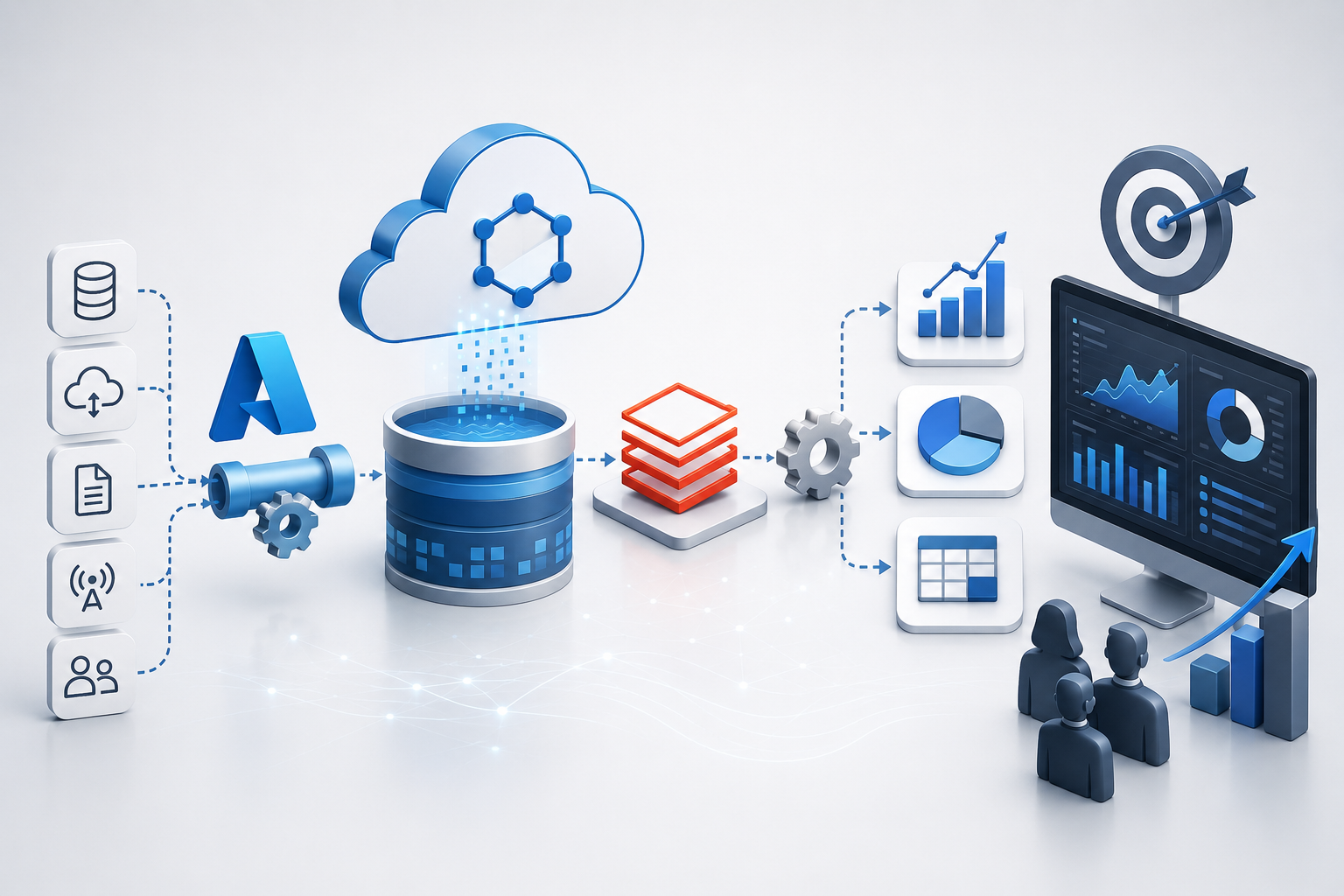
How Azure Data Engineering Turns Enterprise Data into Business Strategy with Databricks Consulting and BI Services?Raw chunks of business data can transform into insightful business decisions only when its unified and remain capable of scalable cloud processing through an integrated ecosystem. With Azure Data Engineering, organizing raw data into actionable business decision turns easier always. The real power of Microsoft Azure Cloud Data Engineering lies in employing Databricks consultants offering Business Intelligence Services to design interactive and simple reports. Such reports often turn your business decisions into long-term success.
Role of Core Foundations of Modern Data Stack & Azure Databricks Consultants
The primary role of the modern data stack is to build a structured cloud pipeline moving data cleanly from source to an executable business strategy. The process of turning raw data into an executable decision involves the following mechanism shared below,- Ingestion
- Reliable Data Storage
- Processing
- Consumption
- Medallion Architectural Design
- Performance Optimization
- Taking Governance and Security Concerns into Account
- Converting Azure Engineered Data into Business Strategy
- Unified KPI Definitions, establishing a shared semantic metric layer. The same layer is relied on by every department for evaluating identical revenue, framing customer retention, and working on overhead calculations.
- Work on Natural Language Queries by using specialized Databricks tools, converting complex text-search data into standard conversational English for adding it to your financial database.
- Work on prediction action-tracing to generate live Executive Dashboards, not only generating and displaying historical results, but actively simulating the future inventory needs, market pricing, and churn risks.
6 Ways Azure Data Engineering Accelerates Smarter Enterprise Decisions in Canadian SMBs
Most of the CEOs expect the data on the table during Quarterly or Annual Meets. But ever wondered how raw data is converted into high-value business decisions? Well, that's the magic of integrating Enterprise Analytics, reshaping your unified siloed data into real-time production. With Azure Data Factory, Azure Data Lake Storage, and Azure Synapse Analytics, you always gain an extra edge for generating revenue-driven insights that include-- Centralized Storage Platform
- Compact View of Entire Database
- Data Processing Is Faster and Quicker
- Growth Flexibility
- Involvement of Live Dashboards
- Keeping Every Data AI-Ready
Top 10 Differentiators of Azure Databricks Data Intelligence Platform – What are They?
- Usually, Unified Lakehouse architecture merges warehouse-style tables and raw data lake storage in one layer. It cuts down duplicate copies of the same dataset and reconciliation work, keeping them in sync.
- Azure Databricks facilitate conversational BI-powered data-driven solutions with Genie, empowering non-technical users to query complex data safely through an NL (Natural Language)- focused built-in ontology.
- Embeds with Agentic Workflow directly by using AI coworkers and supervisor agents directly into Microsoft 365. They also integrate with Teams and Copilot Studio for automating enterprise tasks seamlessly.
- Ensures strict data governance through native integration with Azure identity and security tooling to facilitate a separate access-control system.
- Uses Microsoft Fabric Bridge to manage and store tables directly inside Microsoft One Lake to eliminate cross-platform friction and avoid data duplication.
- Azure Databricks always ensure, serverless PostgreSQL that’s fully managed with instances running natively on lake storage with automatic scaling and fast failover.
- With Azure Databricks, your data platform delivers up to 6X faster performance than traditional legacy warehouse engines. That way, your leadership boards can fetch heavy data processing analytics with optimized engine performance.
- Deployment of Azure Cobalt Infrastructure to enhance output for data-intensive and agentic tasks.
- Access to Open Lakehouse format with zero-lock-in facility involving open-source standards like Delta Lake, Apache Spark and Apache Iceberg v3 support.
- With the Azure Databricks data intelligence platform, you always have the scope to allow external engines like Flink or Spark to read and write directly to manage Delta format governing structured data and unstructured files.
Why Is Enterprise Data a Strategic Business Asset for Small Businesses in 2026?
Most of the Canadian start-ups suffer from scattered data, sharing their years of historical business information, client database, financial records and other valuable assets. Modern CEOs opt for Azure Data Engineered platforms to unify this data into a singular platform that’s easy to access via: -- Organized ERPs
- CRMs
- HR Software
- Manufacturing System
- Custom supporting platforms
- IoT devices, etc,
| Databricks Consulting | Data Strategy |
| More into Technical Blueprint implementation by using Lakehouse constructs, Delta Lake, and Unity Catalogue. | Sets business outcomes, target capabilities, and investment priorities before writing code. |
| Best for optimizing serverless computing, using ETL and ELT data pipelines, and real-time streaming Azure Databricks workflows on multi-cloud environments. | Determines AI agents, data products, and governance models aligning with executive goals. |
| Reduces migration risks and cuts additional costs for deploying cloud data infrastructure. Emphasizes scaling machine learning models into production. | Establishes organizational data literacy, ownership, and value metrics over specific tools. |
How Does Azure Data Engineering Power Business Intelligence Services Turn Dashboards into Business Decisions?
- Facilitating Dashboard-Driven Business Decisions
- Actionable Context
- Better Processing and Modelling Scale
Can AI Replace Azure Data Engineers?
Well, most of the AI tools AI tools generate a fair amount of boilerplate pipeline code. Most of these tools are reliable to speed up repetitive actions. Whether it’s about writing a standard extraction script or about suggesting a schema, you can always rely on AI for performing the job role of a tool engineer.Conclusion
Enterprise data barely impacts your business by initiating wrong decisions. It always keeps your system connected by maintaining a reporting mechanism that consistently works across teams. With Azure Data Engineering laying the basics of your ETL and ELT pipeline, Databricks consulting solutions configure your existing data platform into BI-powered decisions easily.FAQ’s: -
- What is Azure Data Engineering, and why is it important for enterprises?
- What does Databricks Consulting help organizations achieve?
- How do Business Intelligence Services improve business performance?
- Is Azure Databricks suitable for Regulated Industries?