How To Find the Best Online Platforms Offering Data Engineering Courses with Cloud-Based Big Data Tools?
16 July 2026
The highly competitive data-engineering qualification-focused job market will unleash hundreds of employment opportunities for budding data engineers in 2026. But the question is, are you aiming for a general data engineering career or looking ahead to a data engineering with Databricks course specialization in this field?
If you’re aspiring to an attractive yearly salary package, then SQL, Python, and ETL (Extract, Transform, and Load pipelines) should be at the top of your priority list to build a dream career. Apart from that, job-ready employment scopes also expect data engineers with sound knowledge of AWS, Azure, and GCP, with a practical, hands-on, and focused academic curriculum involving training in real-world projects.
However, choosing the right data engineering course with cloud training, Azure Databricks certification, and a big data specialized engineering course might not be easy, unless you know the right platform to upskill your data engineering skills.
Since most of the top-tier MNC’s prefer job-ready candidates to take control of their data consulting teams, only potential learning platforms offering professional Power Automate courses push you towards a thriving career in data engineering with specializations in detailing, tech stacks, prerequisites, etc.
Why Data Engineering with Databricks course specialization matter in 2026?
Most of the aspiring data engineers still believe that academic grades are the ultimate way to build a promising career in data engineering!
Believe it or not, they are no longer applicable now.
The interview panellists really don’t care about your degree or certification. They care about your confidence, practical knowledge and skill-set as soon as you walk into the interview panel. That’s because a hiring manager always looks for someone he/she can trust with the production data and with real-time practical knowledge of ‘getting a complex job done’ almost effortlessly. They also look for knowledge of using AI-powered search tools, and other BI-platform specific navigational features and technical knowledge to explain your knowledge in lucid and simple language.
Well, this job-focussed BI-Power automate course equips you with the required practical on-the-job cloud data skills to grab high-salary jobs associated with data analytics consulting services in 2026.
7 Reasons Modern Data Consulting Firms Highlight Data Engineering with the DataBricks Course
Most of the data engineering with Databricks course certification has reshaped the entire modus operandi of the academic curriculum of lesson plans shared in data engineering training modules for different kinds of job-specific business intelligence training or Enterprise data engineering training courses.
Earlier, data engineering lessons were a standalone course. However, with changing times, now most of the companies expect specialized hands-on training of cloud data engineering platforms, with real-time practical knowledge of ETL pipeline development, where every tool related to Big Data is taught according to the context. Moreover, the in-depth topic of the training process doesn’t just explain the theoretical concepts of the cloud ETL pipeline development framework.
Modern data consultants frame their training module to empower the trainees with a project-style training module addressing on-the-job business-specific problems for which clients prefer hiring data consulting partners in their business. Primarily, modern data consultants prioritize Databricks in data engineering to-
- Build Unified Lakehouse Architecture by combining Databricks with the strength of data lakes and data warehouses, helping modern consultants to break data silos easily.
- Enable accelerated AI and ML programs to provide native tools for AI integrations. Enabling consultants to build pipelines that feed fresh, accurate data directly to AI systems, meeting the critical market needs.
- Train the existing resources on deploying cloud and serverless computing training offering serverless solutions to scale up automatically, reducing overhead costs.
- Allow consultants to build cost-effective, efficient and scalable cloud solutions with the trained in-house staff certified with AWS, Azure and GCP specialization.
- Teach the in-house teams to deal with real-time data processing while streaming data pipelines, which are the foundations of modern tasks like fraud detection, IoT analytics, etc.
- Simplify the process of replacing complex tools with a streamlined workflow in
- Equip the in-house data bricks specialized data engineers to handle and operate, and collaborate on the same code effortlessly.
5 Steps to Find the Right Data Engineering with DataBricks Course for Using Cloud-Based Big Data Tools
If you’re headstrong about finding the right Databricks-specialized data engineering course, your lesson curriculum must focus on modern Lakehouse architecture, PySpark execution optimization and serverless data orchestration. The ideal course must cover live automated data pipelines in production. The best learning path to choose one such career-driven certification is to consider the steps shared below.
- Turn the pages of your Core Big Data learning module
Never settle for a course that handles the baseline skills. Rather, look out for a course that completely focuses on SQL mastery, Python foundations and Cloud basics. It empowers you to ‘SELECT’ queries, ‘JOIN’ operations and data aggregation scripts. Whereas training with Python foundations strengthens your dictionaries, custom functions and the basics of your object-oriented data processing. With explicit knowledge of Cloud Basics, you can always expect a learning outcome of working in practical environments using AWS, Microsoft Azure and Google Cloud Platform.
- Examine the Databricks Tool Stacks in your learning module
A career-focused Databricks tool stack teaches you to use multi-hop pipelines to structure data in Delta Lake & Medallion Architecture. It empowers you to craft a data pipeline, structuring raw data into cleansed, structured, business-ready data. CEO’s and leadership teams prefer such structures to manage their daily Databricks workflow. It also equips you with the use of an incremental data ingestion framework, replacing legacy manual ingestion pipelines. Such learning models enable you to build serverless orchestration modules for automating job scheduling in a real-time scenario.
- Choose the Right Course Level Always
Select a course that aligns strictly with your current professional proficiency level. If needed, use the beginner path and target foundational platform setup. Look out for courses offering intermediate associate paths emphasizing hands-on lab environments. It will train you to acquire pipeline development skills. Prioritize a program that empowers you to manage cost control while streaming configurations with a complex multi-source processing architecture.
- Choose Cloud Ecosystem Integration
By shortlisting cloud ecosystem integration, Databricks don’t run in a vacuum. They are heavily dependent on the underlying cloud ecosystem. If possible, choose a program teaching you to manage Azure Data Factory alongside Azure Databricks. The course must include the AWS tech stack that connects Databricks natively to AWS S3 storage buckets, covering IAM security configurations and AWS Glue.
- Try to Select Projects offering Hand-On Training
Reject courses that rely on theoretical video slide decks. The course must enable you to deploy actual pipelines that include: –
– End-to-end multi-hop project utilizing structured streaming data.
– Check out realistic troubleshooting labs teaching PySpark performance tuning, schema enforcement, and data lineage tracking.
If the course aligns with industry, any of the Data analytics consulting training certifications, like ETL pipeline development, governance rules and system testing methods, consider it as an added leverage for your business.
Conclusion
Choosing the right data engineering course with a Databricks certification is not about picking any random course. It’s about finding an ideal program that matches your job prospects, ensuring a high salary package from the beginning of your career. Apart from that, an ideal data engineering with Databricks course certification must upgrade your ordinary data engineering knowledge into applied skills for practical execution.
If you’re willing to adapt advanced DataBricks engineering skills that connect your learning outcome with a result-driven outcome, choose a program that empowers you to resolve real-time business situations in 2026. It will always keep you job-ready for attractive job roles associated with data bricks engineering specialization.
Related Posts
26 June 2026
Azure Logic Apps vs Power Automate: Which Platform Delivers Scalable Results?Azure Logic Apps vs Power Automate: Which Platform Delivers Scalable Results?
Modern CEOs and decision makers racing to keep up the pace with rapid market shifts often get confused about picking the right workflow engine built by Microsoft. But most of them fail to analyze the real difference between Logic Apps and Power Automate while choosing Azure integration services for their existing businesses. Transform your business with data-driven decision-making, intelligent automation, and scalable cloud solutions. At iDataScientist, we help organizations unlock the full potential of their data through Power BI Consulting, AI Consulting Services, Workflow Automation Services, and Azure Data Engineering solutions. Do you know why? Here’s the explanation.Logic App vs. Power Automate – Major Differences Identified
While comparing Logic apps vs Power Automate, initially, both platforms might look the same, but there’s a huge difference in their work mechanism. Data is only valuable when it delivers insights. Our Power BI Consulting services help businesses visualize complex datasets, create interactive dashboards, and generate real-time reports that support faster, smarter decisions. Whether you need executive dashboards, KPI tracking, or advanced analytics, our experts design customized Power BI solutions tailored to your business objectives. Artificial Intelligence is transforming how organizations operate. Our AI Consulting Services help businesses identify opportunities for automation, predictive analytics, machine learning, and generative AI implementation. We work closely with your team to develop AI strategies that improve operational efficiency, enhance customer experiences, and drive sustainable growth. Although the global market for low-code/no-code platforms has reached 37.4 billion US$ in 2025, and is expected to reach close to 32.2% by 2032, most of the leadership teams still find these platforms quite confusing even in 2026. Manual processes often lead to delays, errors, and increased operational costs. Our Workflow Automation Services streamline repetitive tasks, automate approvals, integrate business applications, and optimize workflows across departments. From finance and HR to sales and customer service, we help businesses improve productivity while reducing manual intervention. The growing labor shortages and rising operational costs have shifted the trend from experimenting with business process automation to adopting firm workflow automation services across Canada and data consulting services for business growth. Recently, Canadian data experts have identified the primary gridlocks of avoiding AI adoption, surfacing some of these real-time problems listed below. Let’s pin down their key basic features.- Azure Logic App
- Power Automate
Azure Logic App vs. Power Automate - Key Features
- Easily Integrates with Other Azure Services
- Known for Rapid Deployment
- Enterprise-grade security ensured
- Empowering B2B Messaging Infrastructure
- Enhanced AI Capabilities
- Automating Everyday Tasks
- Improving Workforce Productivity
- Seamless Integration with 300+ applications
- Integrates with Co-Pilot
- Intelligent Self-Healing Mechanism
- Processes Mining Studio
A Few Limitations of Azure Logic App vs. Microsoft Power Automate Platform
Azure Logic App- Capable of running only on Azure-managed servers and lacks an advanced workflow.
- Limited customizable features available.
- Require multiple data variations for large and complex program models, making it difficult to build.
- Difficult to track and control while working on a complex workflow
- Troubleshooting the problem is never easy while working on large-scale projects.
- Supports sequential workflow and supports only 250 actions per workflow.
- Face challenges while dealing with complex enterprise-grade workflow processes.
- Not suitable for long-lasting workflow.
- Requires highly advanced coding for customized processes.
- The specific workflow can be saved for 30 days only.
Why Choose iDataScientist to Select the Right Azure Integration Services for Your Business?
At iDataScientist, we bring our 21+ years of experience in data engineering and data architecture for helping businesses to take data driven business decisions with clarity and confidence. Whether you’re still debating over Azure logic apps vs. Power Automate, we help you to map out the ideal tool, architecture and model that fits your budget. With us, there’s no guesswork. Expect just data-backed guidance, navigating your business towards value-added decisions from day one. FAQ’s:- How to understand the key difference between Azure Logic Apps and Power Automate? Azure Logic Apps are designed for enterprise-grade integrations, complex workflows, and large-scale automation. But that’s not the case with Power Automate. It’s meant to empower businesses looking for low-code automation involved in everyday tasks, followed by approvals. What Should Be The Best Platform to Automate Enterprise Workflow? Azure Logic Apps are generally known for better enterprise workflow automation services meant for better and advanced orchestration, API integrations. These are also known for offering scalable governance controls supporting complex business processes. Should I choose Power Automate for My Small Business? Of course you can. Power Automate is always ideal for your small and medium-sized business in many ways, as it reduces your manual burdens to automate repetitive tasks without investing additionally in development resources or infrastructure. How Do Azure Logic App facilitate Azure Integration Services in My Existing Business Workflow? Azure Logic Apps connects applications, databases, APIs, cloud platforms, and on-premises systems through a wide range of connectors, making it suitably powerful for Azure integration services. Can Azure Logic Apps and Power Automate work together? Yes, Azure Logic Apps and Microsoft Power Automate platforms work together for user-focused business workflows. Power Automate focuses on user-focused workflows, whereas Azure Logic Apps manage complex backend integrations and enterprise automation.What are Power BI Consulting services?
Power BI Consulting services help businesses create dashboards, reports, and analytics solutions that convert raw data into actionable insights.
How can AI Consulting Services benefit my organization?
AI Consulting Services can improve efficiency, automate processes, enhance forecasting accuracy, and uncover valuable business insights through advanced analytics.
What are Workflow Automation Services?
Workflow Automation Services automate repetitive business processes, reducing manual effort, improving accuracy, and increasing productivity.
Why is Azure Data Engineering important?
Azure Data Engineering provides the foundation for modern analytics, enabling organizations to manage, process, and analyze large volumes of data efficiently and securely.
Partner with iDataScientist to leverage Power BI Consulting, AI Consulting Services, Workflow Automation Services, and Azure Data Engineering solutions that drive digital transformation and business growth.

30 June 2026
How to Hire a Data Consultant in Canada: 10 Proven Tips SharedHow to Hire a Data Consultant in Canada: 10 Proven Tips Shared
The importance of data analytics in business growth is inevitable since James McKinsey reshaped the meaning of strategic guidance with data-driven decision-making for small businesses. In 2026, businesses need a sustainable data-driven analytics strategy to transform raw data into business opportunities, which are often ignored in traditional data management practices. That’s where small businesses need a professional data consultant in Canada to utilize a modern data integration system for monitoring the latest business trends forecast the future business risks to take informed decisions. The rise of modern data strategy consultant agencies offering custom data architecture has empowered Canadian SMBs with modern data engineering structures and advanced data analytical skills to survive the competitive business environments. Why Do Businesses Need a Reliable Data Consultant in Canada Before Executing Business Decisions? Recent reports claim that 80% of Canadian start-ups prefer data analytics as the ultimate turnkey for their business expansion. Modern CEOs and leadership boards prefer trustworthy data analytics experts to put the most flexible business solutions on the table in their annual reports, as real-time data-driven business intelligence consulting solutions provide measurable business value through: -- Strict Regulatory Compliance – Professional data experts navigate through rigorous data privacy laws, ensuring relentless data governance as per PIPEDA regulatory guidelines. Modern enterprise data consulting services include actionable insights from local market trends aligning with your business niche by remaining compliant with PIPEDA and Bill C-27 guidelines.
- Cost-Optimized AI-driven Solutions – Reliable data consultation agencies will never ask you to spend on external consultants with predictive analytics and data modelling, without the overhead of maintaining a full-time in-house team.
- Streamlined Business Decisions– Expert data consultation agents provide streamlined business decisions to handle complex data challenges, offering data strategies aligned with your business goals, identifying the business trends and patterns of the localized market and hidden opportunities associated with it.
- Enhanced business operations – The rise of managed analytics helped Canadian SMBs with outsourced data operations to focus on core functions with continuous data analysis.
- Integrating Data Science with AI to Add Value - Most of the start-ups prefer using advanced algorithms to analyze patterns while predicting outcomes to initiate a smarter decision-making process. The rise of custom AI tools using AI software development solves specific business challenges like automating workflows with enhanced customer support. Moreover, expert data analysts work on evaluating valuable data insights from huge datasets to identify current trends, opportunities and upcoming business risks, thereby helping your newbie start-up to eliminate the threats eventually.
Recent Facts on Enterprise Data Strategy and Consulting Solutions in 2026
The ongoing economic uncertainty, geopolitical crisis and rapid evolution of AI have driven most of the businesses to prefer a data consultant in Canada to strategize decisions aligned with their business goals. More than 45% of local businesses now prefer to increase the capabilities of their in-house data management. That’s where reliable data strategy consulting agencies get maximum priority to provide sector-specific depth and expertise in ESG compliance, Data localization and to streamline common challenges in the absence of precise data-driven insights. A recent survey by expert data analysts claims that: -- Most of the CEOs and leadership teams now prefer technologies creating value and their necessary implementation.
- The AI-powered predictive analytics data has projected business growth for local businesses from 10.1 billion US$ in 2025 to 90 million US$ by 2035.
- The overall market for data consulting services will grow from 390 billion US$ in 2026 to 495 billion US$ in terms of revenue growth by 2031.
- By 2031, the data consultation market revenue is expected to grow faster with 7% compound annual growth.
 Tips to Choose an Ideal Data Consultant in Canada
- Identify the right channel first
- Choose an Ideal Mentor for Your Small Business
- Evaluate your Requirements first
- Choose someone ready to start with an initial data audit for a few weeks
- Choose an Ecosystem Meeting Your Requirements
- Stop Being Generic, try to be Specific
- Evaluate their Industry-specific knowledge
- Look out for a fair and competitive Rate
- Is the Agency PIPEDA Compliant?
- Never appoint a consultant without checking their Technical Expertise
Why Choose iDataScientist As Your Data Consultant in Canada?
As a reliable data consulting partner, at iDataScientist, we always look ahead to help newbie Canadian SMBs to –- Transform their complex data into business outcome-driven decisions.
- Implement cloud data modernization, analytics engineering, and business intelligence solutions.
- Improve daily workflow with workflow automation, Microsoft Azure Data Platform.
- Enhance your existing operations with a future-ready data ecosystem supporting sustainable growth.
30 July 2026
How Azure Data Engineering Turns Enterprise Data into Business Strategy with Databricks Consulting and BI Services?Raw chunks of business data can transform into insightful business decisions only when its unified and remain capable of scalable cloud processing through an integrated ecosystem. With Azure Data Engineering, organizing raw data into actionable business decision turns easier always. The real power of Microsoft Azure Cloud Data Engineering lies in employing Databricks consultants offering Business Intelligence Services to design interactive and simple reports. Such reports often turn your business decisions into long-term success.
Role of Core Foundations of Modern Data Stack & Azure Databricks Consultants
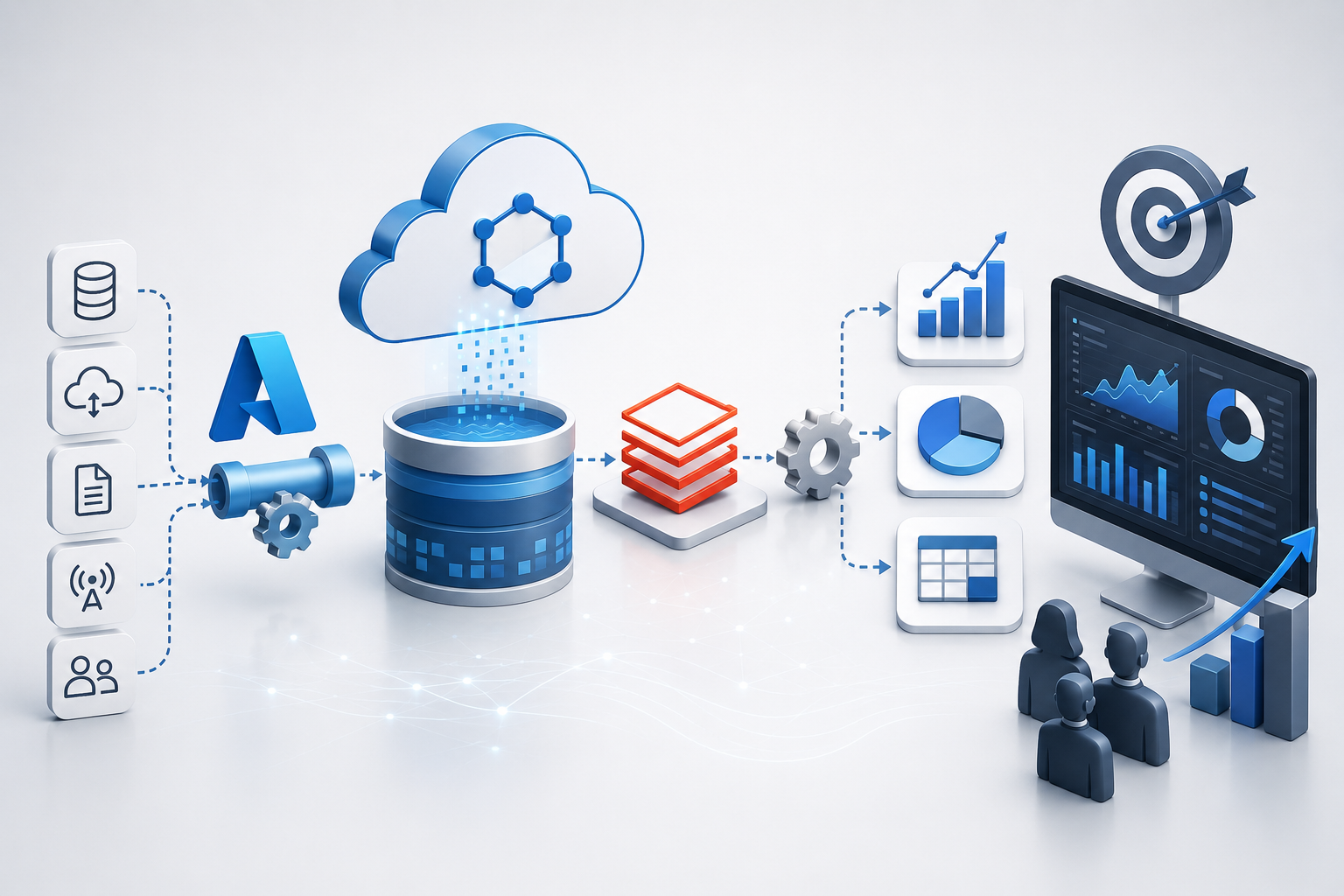
The primary role of the modern data stack is to build a structured cloud pipeline moving data cleanly from source to an executable business strategy. The process of turning raw data into an executable decision involves the following mechanism shared below,- Ingestion
- Reliable Data Storage
- Processing
- Consumption
- Medallion Architectural Design
- Performance Optimization
- Taking Governance and Security Concerns into Account
- Converting Azure Engineered Data into Business Strategy
- Unified KPI Definitions, establishing a shared semantic metric layer. The same layer is relied on by every department for evaluating identical revenue, framing customer retention, and working on overhead calculations.
- Work on Natural Language Queries by using specialized Databricks tools, converting complex text-search data into standard conversational English for adding it to your financial database.
- Work on prediction action-tracing to generate live Executive Dashboards, not only generating and displaying historical results, but actively simulating the future inventory needs, market pricing, and churn risks.
6 Ways Azure Data Engineering Accelerates Smarter Enterprise Decisions in Canadian SMBs
Most of the CEOs expect the data on the table during Quarterly or Annual Meets. But ever wondered how raw data is converted into high-value business decisions? Well, that's the magic of integrating Enterprise Analytics, reshaping your unified siloed data into real-time production. With Azure Data Factory, Azure Data Lake Storage, and Azure Synapse Analytics, you always gain an extra edge for generating revenue-driven insights that include-- Centralized Storage Platform
- Compact View of Entire Database
- Data Processing Is Faster and Quicker
- Growth Flexibility
- Involvement of Live Dashboards
- Keeping Every Data AI-Ready
Top 10 Differentiators of Azure Databricks Data Intelligence Platform – What are They?
- Usually, Unified Lakehouse architecture merges warehouse-style tables and raw data lake storage in one layer. It cuts down duplicate copies of the same dataset and reconciliation work, keeping them in sync.
- Azure Databricks facilitate conversational BI-powered data-driven solutions with Genie, empowering non-technical users to query complex data safely through an NL (Natural Language)- focused built-in ontology.
- Embeds with Agentic Workflow directly by using AI coworkers and supervisor agents directly into Microsoft 365. They also integrate with Teams and Copilot Studio for automating enterprise tasks seamlessly.
- Ensures strict data governance through native integration with Azure identity and security tooling to facilitate a separate access-control system.
- Uses Microsoft Fabric Bridge to manage and store tables directly inside Microsoft One Lake to eliminate cross-platform friction and avoid data duplication.
- Azure Databricks always ensure, serverless PostgreSQL that’s fully managed with instances running natively on lake storage with automatic scaling and fast failover.
- With Azure Databricks, your data platform delivers up to 6X faster performance than traditional legacy warehouse engines. That way, your leadership boards can fetch heavy data processing analytics with optimized engine performance.
- Deployment of Azure Cobalt Infrastructure to enhance output for data-intensive and agentic tasks.
- Access to Open Lakehouse format with zero-lock-in facility involving open-source standards like Delta Lake, Apache Spark and Apache Iceberg v3 support.
- With the Azure Databricks data intelligence platform, you always have the scope to allow external engines like Flink or Spark to read and write directly to manage Delta format governing structured data and unstructured files.
Why Is Enterprise Data a Strategic Business Asset for Small Businesses in 2026?
Most of the Canadian start-ups suffer from scattered data, sharing their years of historical business information, client database, financial records and other valuable assets. Modern CEOs opt for Azure Data Engineered platforms to unify this data into a singular platform that’s easy to access via: -- Organized ERPs
- CRMs
- HR Software
- Manufacturing System
- Custom supporting platforms
- IoT devices, etc,
| Databricks Consulting | Data Strategy |
| More into Technical Blueprint implementation by using Lakehouse constructs, Delta Lake, and Unity Catalogue. | Sets business outcomes, target capabilities, and investment priorities before writing code. |
| Best for optimizing serverless computing, using ETL and ELT data pipelines, and real-time streaming Azure Databricks workflows on multi-cloud environments. | Determines AI agents, data products, and governance models aligning with executive goals. |
| Reduces migration risks and cuts additional costs for deploying cloud data infrastructure. Emphasizes scaling machine learning models into production. | Establishes organizational data literacy, ownership, and value metrics over specific tools. |
How Does Azure Data Engineering Power Business Intelligence Services Turn Dashboards into Business Decisions?
- Facilitating Dashboard-Driven Business Decisions
- Actionable Context
- Better Processing and Modelling Scale
Can AI Replace Azure Data Engineers?
Well, most of the AI tools AI tools generate a fair amount of boilerplate pipeline code. Most of these tools are reliable to speed up repetitive actions. Whether it’s about writing a standard extraction script or about suggesting a schema, you can always rely on AI for performing the job role of a tool engineer.Conclusion
Enterprise data barely impacts your business by initiating wrong decisions. It always keeps your system connected by maintaining a reporting mechanism that consistently works across teams. With Azure Data Engineering laying the basics of your ETL and ELT pipeline, Databricks consulting solutions configure your existing data platform into BI-powered decisions easily.FAQ’s: -
- What is Azure Data Engineering, and why is it important for enterprises?
- What does Databricks Consulting help organizations achieve?
- How do Business Intelligence Services improve business performance?
- Is Azure Databricks suitable for Regulated Industries?

10 August 2026
Why Business Intelligence Services are Essential for Competitive Advantage?The Canadian business landscape has no space for traditional reporting tools in 2026. Most Canadian businesses prefer advanced Business Intelligence services over relying on spreadsheets and gut instinct. Whether you’re running a five-person startup in Toronto or running a company with 200 employees, you need a reliable tool to convert your raw data into clear business decisions.
Business Intelligence Services –Another Name for Dependency in Modern Businesses
By involving a BI analytics tool, you can always find a direction to steer your business by reducing your decision-making gaps. Most of the start-ups prefer BI-powered Predictive Analytics to execute intelligent business decisions with –- Agentic AI that’s not just a dashboard any longer. It’s used to automate activities like data analysis and execution with zero human intervention.
- Identify potential business leads, which have 6 times more chances to retain. Because BI-powered AI data enables your business to engage your targeted customers by making you 19 times more profitable in your business.
- Improve your revenue generation scope, as a recent report claims that 43% of AI-generated reports have increased profitability among US and Canada-based businesses.
- Increase revenue growth by 80% in every business across key sectors like finance, manufacturing, and telecom. It has also grown their revenue specifically by leveraging real-time data capabilities.
- Data-driven decisions, helping around 65% of businesses to take prompt strategic decisions without a ‘gut feeling’.
What is Business Intelligence Services & Why Small Businesses Need It?
Business Intelligence (BI) is a technology that’s equipped to turn raw data into clean visual insights. Modern businesses prefer it to get AI-driven, conversational analytics for eliminating guesswork and ‘gut-feeling’ driven decisions. Be it about tracking cash flow, optimizing tight budgets, implement fact-based decisions, it’s the ultimate lifeline for modern businesses looking for sustainable growth. Primary Role of Business Intelligence Services – Overview- Enhances Data Collection –
- Improves Data Integration
- Simplifies Data Visualization
- Putting Data into Action
- Quick Decision Making
- Waste Reduction
- Choosing the Right AI Tool
- Better Transparency in Cash Flow
How Business Intelligence Services Add Competitive Advantage to Your Small Business?
Believe it or not, the strongest advantage of any business is to make speedy and successful decisions. That’s because clients barely care about the process of making such a decision. They need results. Usually, Business Intelligence-powered solutions help SMB owners protect their business from declining performances like declining sales figures, rising service costs, changes in customer behavior, etc. That way, they assist you to take a call while the opportunity still exists. Let’s find out how BI solutions work,| Key Features Introduced with Power BI | What Does It Actually Do? | Impact of BI on Your Business |
| Executive Dashboards | Integrates sales, website and pricing-related data under a single platform | Saves manual work hours by speeding up your choices to make decisions |
| Deploying Predictive Analytics | Minutely look into past sales to predict future demand | Work on product shortages by cutting overstock |
| Key Performance Tracking | Measure daily goals against real results | Helps you to pinpoint your problems before even seeing profit |
- Pinpointing precise insights from millions of data points that benefit your business.
- Monitoring the key metrics consistently for making better decisions that ordinary dashboards can’t provide in 2026.
- Analyzing pricing gaps, supply delays, or patterns of customer complaint bothering your daily workflow while working from memory and monthly reports.
- Professional Enterprise Data Consulting firms not only install software but also map your specific region where decision-making is necessary. Be it about inventory, pricing or staffing, etc., which are pivotal to move your business in a positive direction.
- Drafting simple reports for your leadership teams that are more like an overview of your last few months/last quarter’s KPI metrics, to take quick decisions instantly in a boardroom meeting without wasting time.
Do Small Canadian Start-ups Get ROI from Business Intelligence Services?
Of course! Investing in Business Intelligence (BI) always leads you to gain an average ROI of $13.01 (approx.) for every dollar. Recent research claims that, apart from increasing your revenue, it cuts labor cost, reduces hours spent on manual spreadsheets, while speeding up everyday decisions. Few benefits unlocked with ROI-driven BI-powered solutions-- Slashing labor cost for drafting manual report.
- Enhance real-time tracking limits by saving inventory wastage while fixing workflow slowdowns parallelly.
- Improve sales growth with clear data helping businesses to spot upsell chances by reducing customer loss.
- Take less time on waiting data means via quicker response to market shift.
- Ensure better visibility of real-time scenario from guesswork to concrete decisions.
- Identifying precise problems like loss of stock cost or client loss while training staffs to set aside time and budget.
- Measures the saved hours every day that you gain by increasing your sales generation chances regularly.
- Empowering you with quicker response to a sudden market shift.
- Enhance better visibility for helping you to monitor time span taken by your team on high-value work to increase revenue generation scopes.
- Offer Corporate Data Training to your existing staff to improve their advanced tool handling skills.
Key Challenges of Implementing BI in Your Business
Every technology comes with its own pros and cons; well, implementing BI is not free from this thumb rule, as well. Implementing Business Intelligence services does have its own hurdles. Some of those challenges have been briefly explained below,- Technical Struggles with Implementing BI
- Poor Data Quality
- Challenges with Accepting New Technology
- Expense Factor
How to Avoid the Common Bottlenecks in Implementing Business Intelligence Services?
Before implementing a BI-powered solution in your business, always look out for these factors first. Try to frame your basic goals aligning with your primary business objectives. Most of the Canadian SMB owners avoid this mistake and ultimately fail to deploy Business Intelligence Solutions in their business. Here’s how you can avoid those-- Match your strategy and plans before spending on BI. If needed, find the business-specific metrics and outcomes before introducing it in your system.
- Keep the executive decision-making board in the loop so that they remain active and support you once the decision rolls out from the discussion rooms.
- Launch a pilot project before making it for full company release. That way, you can always find a demo and evaluate its effectiveness in your business. It will always help you to choose and implement the right BI tool.
- Fix your missing or messy data early while working in the process. If needed, connect the other data structure silos so that you and your teams have access to data generated from a single source of truth.
- Train your internal teams to maintain a positive mindset for accepting new technology. If required, conduct a training session on using a BI-powered dashboard. Grant them time to accept it. Once they adopt it, working with Power BI will become easier for them.
- Take the user feedback seriously. Spend time knowing how they felt after using a dashboard. Before investing in it, have a conversation with your data consulting firm to build a dashboard with clean layouts which are easy to read.
Conclusion
The actual advantage of using Business Intelligence services can be truly unleashed in your business when you start accessing right data faster even than your competitors. When decision making process is fast, strategic executions won’t take much time. That’s possible only when you are aware of the true value of your BI-powered dashboard and its future impact before deploying it in your business.Few FAQ’s
- How long does it take to see results from business intelligence services?
- Do small businesses need a full data team to use BI?
- Which industries benefit most from business intelligence?
- Is business intelligence data secure under Canadian privacy law?